
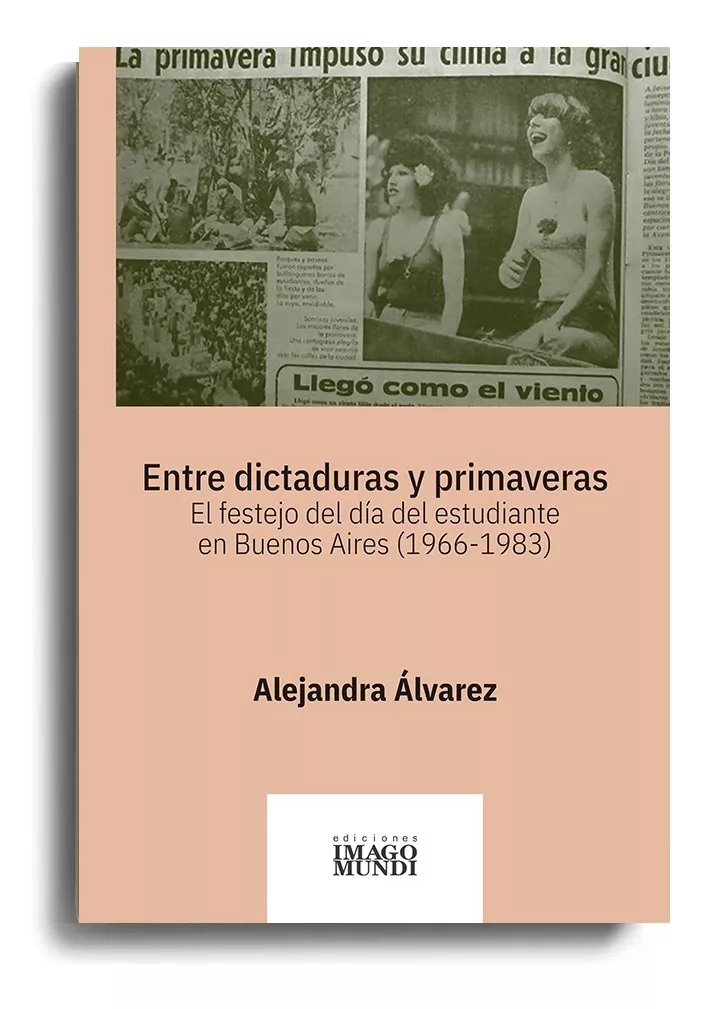
Entre dictaduras y primaveras. El festejo del día del estudiante en Buenos Aires (1966-1983)
Palavras-chave:
secundarios, dictadura argentina, juventud, cultura juvenilReferências
Barr-Melej, P. (2017). Psychedelic Chile. Youth, Counterculture, and politics on the Road to Socialism and Dictatorship. United States of America: The University of North Carolina Press.
Bonavena, P. y Millán, M. (Ed.) (2018). Los ´68 latinoamericanos. Los movimientos estudiantiles, política y cultura en México, Brasil, Uruguay, Chile, Argentina y Colombia. CLACSO.
Enrique, I. (2011). La participación estudiantil en la escuela secundaria en la Argentina. Reconstrucción del conflicto en torno al protagonismo político de los jóvenes. Tesis Doctoral, Universidad de Buenos Aires.
Larrondo, M. (2014). Después de la Noche. Participación en la escuela y movimiento estudiantil secundario: Provincia de Buenos Aires, 1983-2013. Tesis Doctoral, Universidad Nacional de General Sarmiento.
Luciani, L. (2022). Escuela tomada. El movimiento estudiantil secundario rosarino en el gobierno camporista. En Sociohistórica, (N°49). e158. https://doi.org/10.24215/18521606e158
Manzano, V. (2017). La era de la juventud en Argentina. Cultura, política y sexualidad desde Perón hasta Videla. Buenos Aires: Fondo de Cultura Económica.
Markarian, V. (2012). El 68 uruguayo: El movimiento estudiantil entre molotovs y música beat. Bernal: Universidad Nacional de Quilmes.
Matamoros Fernández, C. (2021). Escuela y revuelta. Estudiantes secundarios y actores educativos en el inicio de las protestas de octubre de 2019. En C. Santibáñez y L. Thielemann (eds.), Revueltas. Disturbios y lucha de clases en la metrópolis (pp. 205-240). Valparaíso: América en Movimiento.
Downloads
Publicado
Versões
- 2025-01-04 (2)
- 2024-12-31 (1)
Como Citar
Edição
Seção
Licença
Copyright (c) 2024 REVUELTAS. Revista Chilena de Historia Social Popular

Este trabalho está licenciado sob uma licença Creative Commons Attribution-NonCommercial-ShareAlike 4.0 International License.
Revueltas. Revista Chilena de Historia Social Popular publica seus conteúdos sob a licença Creative Commons Atribuição–NãoComercial–CompartilhaIgual 4.0 Internacional (CC BY-NC-SA 4.0), que estabelece os seguintes termos:
- Atribuição (BY): Deve-se dar o devido crédito à autoria, indicar a fonte original de publicação, incluir um link para a licença e informar se foram realizadas modificações.
- Não Comercial (NC): O material não pode ser utilizado para fins comerciais.
- Compartilha Igual (SA): Se o material for remixado, transformado ou adaptado, a obra derivada deve ser distribuída sob a mesma licença.
Trata-se de uma licença de caráter internacional que permite o uso, a distribuição e a reutilização do material em qualquer meio ou formato, nos termos acima indicados.

